
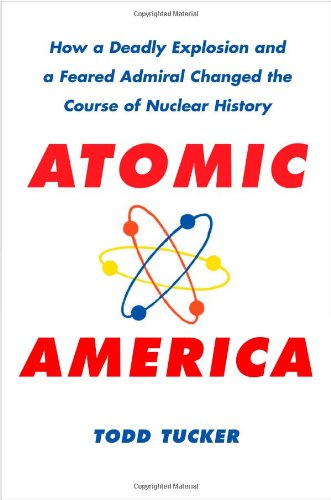
Atomic America: How a Deadly Explosion and a Feared Admiral Changed the Course of Nuclear History
Produktdetails
| Artikelnummer | 237211626 | Erscheinungsdatum | 2026/07/10 | Listenpreis | €4.63 | Modellnummer | 237211626 | ||
|---|---|---|---|---|---|---|---|---|---|
| Kategorie | |||||||||
On January 3, 1961, nuclear reactor SL-1 exploded in rural Idaho, spreading radioactive contamination over thousands of acres and killing three men: John Byrnes, Richard McKinley, and Richard Legg. The Army blamed "human error" and a sordid love triangle. Though it has been overshadowed by the accident at Three Mile Island, SL-1 is the only fatal nuclear reactor incident in American history, and it holds serious lessons for a nation poised to embrace nuclear energy once again.Historian Todd Tucker, who first heard the rumors about the Idaho Falls explosion as a trainee in the Navy's nuclear program, suspected there was more to the accident than the rumors suggested. Poring over hundreds of pages of primary sources and interviewing the surviving players led him to a tale of shocking negligence and subterfuge. The Army and its contractors had deliberately obscured the true causes of this terrible accident, the result of poor engineering as much as uncontrolled passions. A bigger story opened up before him about the frantic race for nuclear power among the Army, the Navy, and the Air Force -- a race that started almost the moment the nuclear bombs were dropped on Hiroshima and Nagasaki.The National Reactor Testing Station (NRTS), where the meltdown occurred, had been a proving ground where engineers, generals, and admirals attempted to make real the Atomic Age dream of unlimited power. Some of their most ambitious plans bore fruit -- like that of the nation's unofficial nuclear patriarch, Admiral Rickover, whose "true submarine," the USS Nautilus, would forever change naval warfare. Others, like the Air Force's billion dollar quest for a nuclear-powered airplane, never came close. The Army's ultimate goal was to construct small, portable reactors to power the Arctic bases that functioned as sentinels against a Soviet sneak attack. At the height of its program, the Army actually constructed a nuclear powered city inside a glacier in Greenland. But with the meltdown in Idaho came the end of the Army's program and the beginning of the Navy's longstanding monopoly on military nuclear power. The dream of miniaturized, portable nuclear plants died with McKinley, Legg, and Byrnes.The demand for clean energy has revived the American nuclear power industry. Chronic instability in the Middle East and fears of global warming have united an unlikely coalition of conservative isolationists and fretful environmentalists, all of whom are fighting for a buildup of the emission-free power source that is already quietly responsible for nearly 20 percent of the American energy supply. More than a hundred nuclear plants generate electricity in the United States today. Thirty-two new reactors are planned. All are descendants of SL-1. With so many plants in operation, and so many more on the way, it is vitally important to examine the dangers of poor design, poor management, and the idea that a nuclear power plant can be inherently safe. Tucker sets the record straight in this fast-paced narrative history, advocating caution and accountability in harnessing this feared power source. Read more
| ISBN10 | 141654433X |
|---|---|
| ISBN13 | 978-1416544333 |
| Edition | First Edition |
| Language | English |
| Publisher | Free Press |
| Dimensions | 6.25 x 1 x 9.5 inches |
| Item Weight | 3.6 pounds |
| Print length | 288 pages |
| Publication date | March 3, 2009 |
Korrektur der Produktinformationen
Wenn Sie Unvollständigkeiten oder Fehler in den Produktinformationen auf dieser Seite bemerken, nutzen Sie bitte das Korrekturformular unten.
Korrekturanfrage